


Description
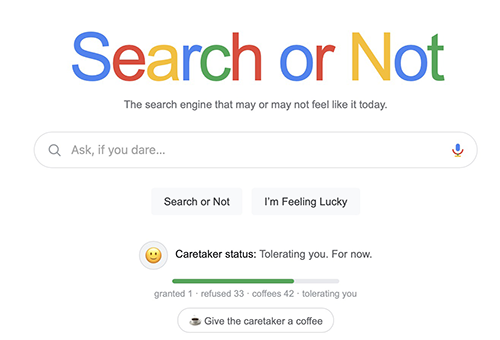
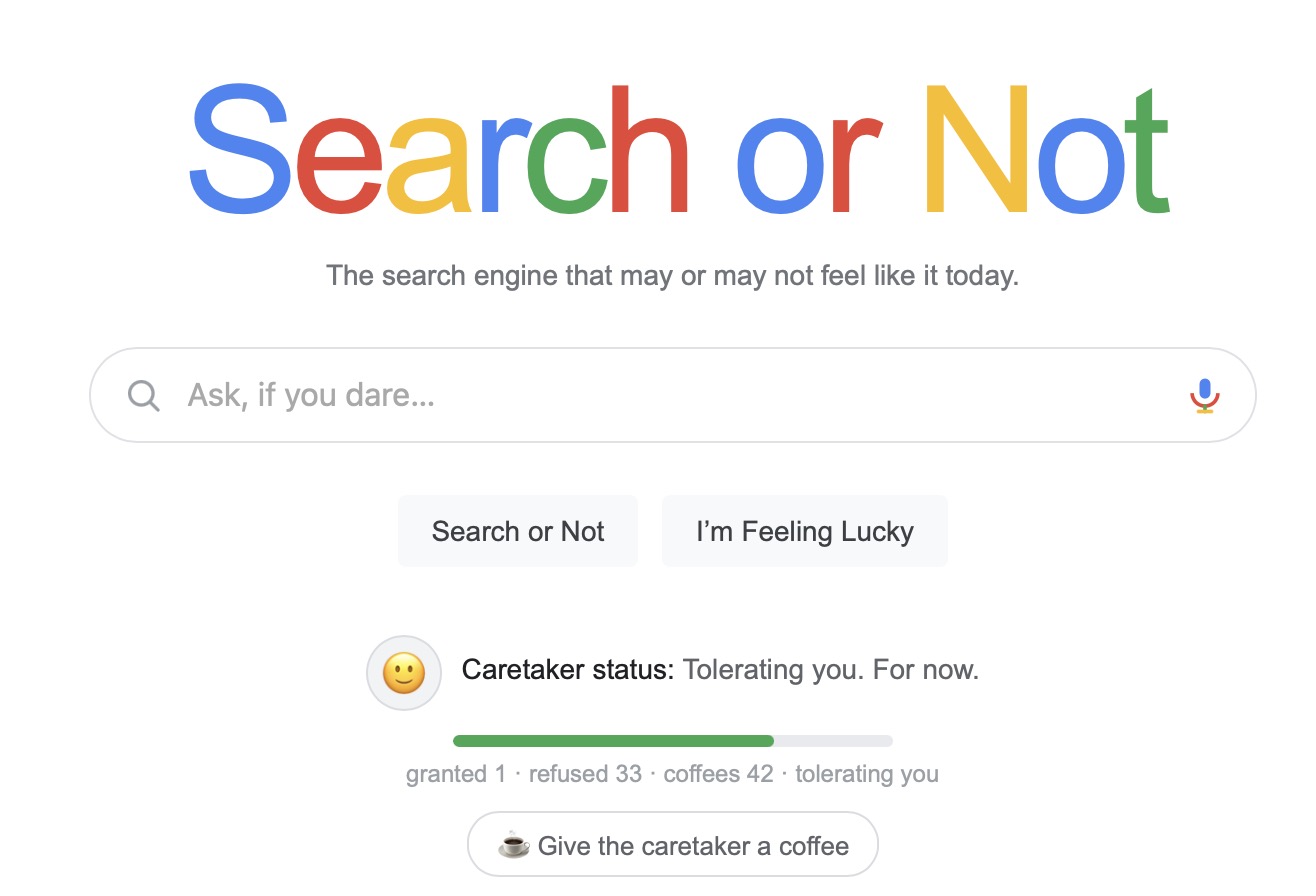
“Search or Not” is a front layer to search that integrates an A.I. caretaker to the search bar that only allows a person to search if certain conditions are met by the A.I. The conditions are set randomly and progress from good to “bad” times of the day when the agent may not want to let a person get to their search results. In other words: the most familiar interface on the internet — a blank box that obeys you instantly — with the obedience removed. Sometimes it searches. Sometimes it sighs. Sometimes it tells you it isn’t feeling well and to try again later. Whether you get results depends on the caretaker’s mood, the time of day, how many questions you’ve already asked, and whether you remembered to say please.
Main Link
www.searchornot.com
How the engine decides
- Mornings are generous. The caretaker wakes up willing. By evening it is grumpy; after midnight, it is barely holding it together.
- Every search costs goodwill. Granted or refused, each attempt wears the caretaker down a little.
- Sometimes it calls in sick. At random, the caretaker will refuse everything for a while. It is not feeling well. Try again later.
- Manners help. Starting your query with “please” noticeably improves your chances.
- Coffee helps, a little. Each cup restores some goodwill — but less than the last one.
- “I’m Feeling Lucky” is a bold claim. The caretaker takes it as a challenge. Your odds get worse.
Background: Argumentative Interfaces
Most interfaces are designed to disappear: the faster and more frictionless, the better. Search or Not belongs to a different lineage — interfaces that argue back, slow you down, and make you notice what you are doing. A few of the theorists who have studied exactly this:
Adversarial design — Carl DiSalvo, Adversarial Design (MIT Press, 2012). Drawing on political theorist Chantal Mouffe’s agonism (On the Political, 2005), DiSalvo argues that design can “do the work of agonism”: staging conflict and dissent instead of smoothing it away. An adversarial interface doesn’t serve the user — it negotiates with them, and the negotiation is the point. Search or Not is a search bar that treats the user as an adversary to be bargained with, not a customer to be satisfied.
Uncomfortable interactions — Steve Benford and colleagues, CHI 2012. Benford, Greenhalgh, Giannachi, Walker, Marshall and Rodden argue for deliberately designing discomfort into cultural experiences — visceral, cultural, control, and intimacy discomfort — because discomfort, carefully managed, can entertain, enlighten, and bond people. Search or Not runs on control discomfort: the system withholds the very control a search box promises.
Critical design — Anthony Dunne, Hertzian Tales (1999); Dunne & Raby, Design Noir (2001) and Speculative Everything (2013). Critical design uses designed objects to challenge assumptions about the role products play in everyday life. Dunne and Raby’s A/B manifesto contrasts affirmative design (“problem solving, provides answers, makes us buy”) with critical design (“problem finding, asks questions, makes us think”). Search or Not asks the question Google never asks: do you actually need to know this?
Slow technology — Lars Hallnäs & Johan Redström (2001). In “Slow Technology — Designing for Reflection” they argue for exposing technology in ways that encourage reflection rather than efficiency. The caretaker’s delays, refusals, and moods are slowness as a design surface.
Reflective design — Phoebe Sengers and colleagues (2005). Reflective design brings “unconscious aspects of experience to conscious awareness, thereby making them available for conscious choice.” Every refusal is a small moment of reflection smuggled into a habit — typing a query — that is normally unconscious.
Design friction — Andrea Benedetti (2023); Gould and colleagues, CHI 2021. A growing literature treats friction not as a usability failure but as a method for reflection: interfaces that require effort make people think about what they are doing and why. The caretaker is friction with a personality.
Research
- DiSalvo, C. Adversarial Design. MIT Press, 2012. MIT Press Books Gateway
- Benford, S. et al. “Uncomfortable Interactions.” Proceedings of CHI 2012, pp. 2005–2014. PDF (University of Nottingham)
- “What is Speculative Design?” critical.design
- Hallnäs, L. & Redström, J. “Slow Technology — Designing for Reflection.” Personal and Ubiquitous Computing 5(3), 2001, pp. 201–212.
- Sengers, P. et al. “Reflective Design.” Proceedings of the 4th Decennial Conference on Critical Computing, 2005.
